Sunday, 19 October 2014

Poh Tiong Choon Logistics

With the recent market decline and a possible market correction going forward, Poh Tiong Choon Logistics, short for PTCL, poses an interesting opportunity.

PTCL, as the name suggests, is a logistic company. It's main businesses involves transportation and bulk cargo and warehousing. They also own several investment properties in which they lease for rental income.

Personally, I believe that logistics is an extremely interesting business to look at, especially in Singapore. As the developing nations continues to grow (China, India, Indonesia, etc), trade activity in Singapore is bound to expand. However, given limited space in Singapore and near vessels, logistic company becomes relevant, especially those with warehousing capabilities.

In addition, the market in which PTCL targets is an interesting and niche one. Chemicals. PTCL have a warehouse in Jurong Island which have storage and drumming capabilities for chemicals which allows them to charge premiums for its services. The chemical industry is also one which seems to be undergoing a period of renaissance with the advent of hydraulic fracturing. Thus I believe that PTCL should experience additional tailwinds in this aspect.

However, the market do not seem to recognize PTCL competitive advantage and opportunity as the core PTCL (Logistics and warehousing) trades at a normalized 4.0x EV/FCFE, 4.0x EV/EBITDA.

Assuming a 2% growth rate (below expected inflation) and a 10% RRR (above PTCL ERP of 6%), the fair value for the core PTCL comes up to be $0.78 per share.

Including the value of the investment properties less a 25% haircut on value, total value of PTCL comes up to be $0.95 per share. or a 40% upside to current prices.

Below is my analysis on PTCL.

For a company which have a ~25% ROIC, 3.6% growing dividend yield and book value growth over time, PTCL is a highly attractive opportunity. 

Saturday, 4 October 2014

Blucora

How much would you pay for a business that should produce near mid double digit revenue growth rate at least for the coming few years which generates ~40% EBITDA margin? 10 times EBITDA? 15 times EBITDA?

Introducing Blucora.

Blucora operates in 3 areas: Search, Tax Preparation and E-Commerce.

Search
The Blucora business model is simple to understand, just think of it as a value added reseller of search engines. If a website owner, lets call him Shaun, wishes to add search functions on his homepage but do not have the expertise or technology to do so, he contact Blucora. Blucora will then contact Google or Yahoo to syndicate their search results. Blucora would then build out portals for Shaun and when someone clicks on a paid ad at his website, everyone gets a cut.

Pretty interesting.

In addition, Blucora owns several legacy search engines such as dogpile.com and webcrawler.com which believe it or not, people still use.
Tax Preparation
Blucora also owns TaxACT. It is a wonderful business. It is a fast growing online tax preparation firm. To understand how wonderful this business is, we have to understand the industry.

The tax preparation industry is dominated by Paid Preparers and the DIY people. Paid Preparers are tax stores such as H&R Block while DIY people are people who fill taxes using paper and pen and online. The market share of each is more or less split, although Paid Preparers is probably the front runner. For now.

Within the DIY segment, more and more people are shifting to online from paper and pen, AND, Paid Preparers are losing market share to the DIY segment. Although, the Paid Preparers will probably have a strong competitive edge due to complexity, but regardless, TaxACT is at the right segment of the industry. In addition, TaxACT has a wonderful business model which creates stickiness. When you are able to create stickiness at an early part of a growth phase and is able to generate high cash margins on that stickiness, you get very interesting results.

E-Commerce
Blucora also own Monoprice, an online retailer that sells consumer electronics under its label. I dont have much of a thought on this segment but it seems to be generating significant free cash flow so that is good.

Valuation
So, currently H&R Block, a paid preparer, trades at 8.2x EBITDA and had low single digits revenue growth. On the other hand, TaxACT had near mid double digits revenue growth rate in 2013. In addition, TaxACT have a lower reinvestment requirement. So, what is the right multiple for such a business?

Well, lets just slap on a 8.2x EBITDA and see what we get. Using the 2013 values (I dont use the LTM due to effects of seasonality, but it is much more conservative anyway), Blucora Tax Preparation business is worth $285 million.
With a 8.2x EV/EBITDA, Blucora Search and E-Commerce implied EV/EBITDA is 4.6x. Wow. 4.6x implied EV/EBITDA is distressed level. Assuming 0% growth, 4.6x EBITDA would imply a ~22% discount rate. That is quite...aggressive, and this is the Bear Case. Using a more conservative, albeit still high, discount rate of 18% and with 2% growth, the implied EV/EBITDA should at least be 6.1x. The Bear Case would then imply a 16.2% upside.
Catalyst
Due to the cash generative nature of this firm, I think that time will be its own catalyst in this case. 

Friday, 3 October 2014

GoPro Part 2

In my last post, I did a relative valuation comparing GoPro to its closest comparable, Nikon. The problem with that is I am comparing two very different company and attempting to use one to price the other.

For one, GoPro has very different margin levels. For another, while the camera industry have been shrinking over the years, it seems that GoPro has buck the trend and produced significant growth, albeit shrinking growth rate. No surprising considering the company had multiple triple digits year. Given the very different circumstances, using comparables' multiple become suspect. Having said this, I decided to embark on valuing the company using a DCF instead.

In order to value GoPro using a DCF, the following inputs are required:

a) Revenue Growth Rate
b) Terminal Growth Rate
c) EBIT Margins
d) Tax Rates
e) Reinvestment Requirements
f) Cost of Capital

Revenue Growth Rate
In order to estimate revenue growth rate, I believe it is appropriate to compare it against the company's competitors.
From the picture above, one can see that GoPro owns only a small size of the camera market. This doesn't necessary have to be a bad thing. It represents market share that GoPro could potentially grab. Of course, GoPro products are niches as compared to its competitors which provide a wider range, but lets just assume GoPro is able to grow its revenue to be more inline with competitors. Why not right?
Assuming GoPro is able to grow its revenue to that inline of Canon, the market leader, the implicit returns is as follow:

Terminal Growth Rate
As you can see from the picture above, the terminal growth rate is 2.4%, or more specifically, 2.44%. This is the US 10 year bond rate. I expect the industry to grow inline with the economy. 

EBIT margin
Since I am looking for the bull case scenario to formulate a margin of safety on shorting GoPro, I have decided to use the highest EBIT margin that GoPro, Olumpus, Canon and Nikon have made over the last 6 years. The highest EBIT margin of 18.7% came from Canon back in 2011. This assumes that GoPro will more than double its existing margin. Well, why not? 

Tax Rate
As for Tax Rate, I use a tax rate of 30%. Doesn't really make sense considering that the company operates in US, which have a 40% corporate tax rate, and had a 41% tax rate in the LTM. Again, why not?

Reinvestment Requirement
Currently, the average reinvestment requirement over the last 4 years of GoPro is 33.5%. Rather than using a 33.5% reinvestment requirement, I use a 25% reinvestment requirement. The lower the reinvestment requirement, the more aggressive the valuation. 

Cost of Capital
Rather than using a growing company cost of capital, I use a lower, more aggressive 8.0% mature company cost of capital. 
With all this factor in play, the intrinsic value of the company comes up to be $158.28 per share. or a 85.2% upside from current prices. Of course, my assumption takes into account of extremely aggressive, near the point of hilarity, assumptions. 

Using a more conservative, albeit still aggressive assumption, value per share drops from the stratosphere. Just by using a 30% initial growth rate, a 15% EBIT margin, a 40% tax rate and a 30% reinvestment rate, value per share drops to $40.85 per share, or a 52% downside to current prices. 

In my opinion, shorting GoPro at $85.46/share represents an attractive opportunity.

Thursday, 2 October 2014

GoPro

GoPro is a company that develops, manufactures and markets action videos cameras. It is the industry leader of this market.

On June 25 2014, GoPro went IPO at $24/share. As of October 1 2014, GoPro trades at $91.80/share. At $91.80/share, I believe that GoPro is extremely overvalued. For a company that operates in a a highly competitive industry with deep pocketed competitors and slowing growth, a valuation multiple of 10x LTM P/S and >100x LTM EV/EBITDA is far too excessive.

In this analysis, I will be using relative valuation to GoPro's competitors. GoPro's closest competitors are Nikon, Canon and Olympus, with Nikon being the closest comparable. The data shown in the following table comes from the the respective companies camera segment.
While GoPro has robust revenue growth, unlike its competitors, one can see that revenue growth has been slowing down dramatically. In addition, from the data, it does not seem that GoPro has any exceptional margins on its products. In fact, relative to comparables, GoPro has one of the weakest margins in the industry. This make sense to me as the demographics that GoPro appeals to does not seem to have high purchasing power. 

On a positive note, the company has lower CAPEX margins than comparables. In order to adjust for this, I believe an (EBITDA - CAPEX) margin would be more appropriate. 
However, even with the adjustments, GoPro still has one of the weakest margins in the industry. 

If one is to be given a scenario where you have a company that has half the EBITDA-CAPEX of its closest comparable, and has a slowing growth rate, albeit not to the point of negative growth rate as it is with the comparable but likely a convergence , I would expect the company to have similar multiples. 

Nope. 
GoPro trades at 18x Nikon, its closest comparable, EV/EBIT and 25x Nikon EV/EBITDA. In my opinion, such a valuation is beyond absurd and shorting this company should provide significant alpha. 

Even if one adjusts EBIT and EBITDA for higher margins. The company still remains wildly overvalued. 
Using the highest EBIT and EBITDA margin of GoPro and all of its competitors in the last 6 years, the MAX EV/EBIT and MAX EV/EBITDA goes to 60.3x and 56.0x respectively. What a valuation. 

So what is the right price? 
With the bull case valuation of $13.27 and a base case valuation of $4.42 on a EBIT basis, I believe that GoPro is an attractive risk/reward situation. 

Saturday, 27 September 2014

Centurion Revisted

In my previous two posts, I spoke about the fact that Centurion is earning below it's cost of capital and has poor capital allocation abilities.

However, one thing that I admit to having missed out is the fact that the company's current earnings potential to the asset base does not fully represent the normalized returns. This is because a huge chuck of value in the asset base is dormitories that are not yet operational, thus current return on capital does not fully represent reality. In addition, I have failed to net out taxes from the cost of debt calculation. This post is to rectify this problem. 

In my opinion, when one attempts to go short a company, just as how one would identify a margin of safety for a long position, one should inverse and identify the best-case scenario and see if that gives one a margin of safety. This was what I did in my DCF calculations. 

I believe that the growth rate that I employ is aggressive. While consensus estimates EBITDA margin to compress slightly towards 50%, I assume margin remains at current levels. 
Next, I assume CAPEX % Revenue to be 45%. I believe this to be aggressive. This assumes that cost of lease per bed per month to be between $105 to $144 for the Singapore portfolio. This is at a 11% to 35% discount to a recent BCA tender of $161.50 per bed per month. 
Following this, I would calculate the company's cost of capital with the post-UK acquisitions expected capital structure. Doing so, WACC comes up to 5.41%. Again, this is significantly below the aggressive and optimistic CIMB research report of 6.9%. To add on, I use a 2.5% terminal growth rate, instead of the 2.0% used by the CIMB analysts. 

I believe this to be sufficiently aggressive. 
Using these assumptions, I determine the aggressive, or bull case, intrinsic valuation comes up to be SG$0.62 per share. This represents a 17% downside, or should I say upside, to current prices. 

I believe this that while the current is significantly below that of historical, shorting Centurion remains to be an attractive proposition. 

Sunday, 21 September 2014

YAHOO: Sum of the parts

In 2010, the investment thesis that David Einhorn of Greenlight Capital had on Vodafone was as straightforward as it was strange. He argues that the market is ignoring the fact that Vodafone owns 45% of Verizon Wireless. While such an opportunity could be expected from small companies without institutional following, Vodafone is a massive entity.

The very same situation is occurring right now with Yahoo.

As you know, Yahoo is a technology search engine company with $4.6 billion in revenue in the LTM. At the current $42 billion market capitalization, this represents a 9.2x Price to Sales ratio. This is an exceedingly high ratio for a company that has mid teens digit EBIT margins and is losing revenue for the last 6 years.

The reason is because investors aren't valuing Yahoo solely on its operating assets, but also the assets that Yahoo owns.

Yahoo owns 35% of Yahoo Japan, an entity separate from Yahoo that operates in Japan. In addition, it owns 401.8 million shares of post-ipo Alibaba.


At current market capitalization, the market is implying that Yahoo Core is worth NEGATIVE $3.6 billion.

In my opinion this is ludicrous and represents an attractive opportunity.

With the sale of 127.1 million shares of BABA and Yahoo current balance sheet makeup, Yahoo Core Est. EV is NEGATIVE $12.47 billion. For a company that made $337M in EBIT in the LTM, this represents an amazing opportunity. 

So, how can one take advantage of this discrepancy?

An illustration: 


For every 1000 shares of Yahoo purchased, one should sell short 1932 shares of Yahoo Japan and 389 shares of Alibaba. By doing this, one can isolate Yahoo's core operating business. 

What is the right price? 

It is hard to say considering that Yahoo Core is in the midst of attempting a turnaround. However, I believe that ascribing a 0.3x EV/Revenue would be more than conservative. This would imply that Yahoo is trading at ~4x EBIT. 

At $54.36, buying Yahoo now represents a 33% upside. HOWEVER, if one executes the hedge and isolates Yahoo Core business, one can theoretically obtain an infinite IRR. Why so? Because at current valuation, the market is ascribing Yahoo Core at less than 0. 

Friday, 12 September 2014

Giordano: Risk Reward

Giordano is leading casualwear retailer in Asia with over 1369 self-operated stores, 842 franchised stores and 449 affiliated stores in 2013. It mainly operates in Greater China, Southeast Asia, Japan and Australia.

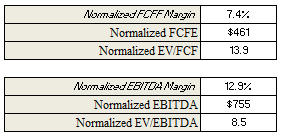
It currently trades at HK$4.58, or a normalized 13.9x EV/FCF or a 8.5x EV/EBITDA. I believe that Giordano is likely undervalued with tremendous upside.
While I do not have much of an unique insight in the apparel industry, I believe that the risk reward makeup on Giordano is more than enough to make up for this deficiency.

Giordano is a company which has tremendous cash generating capabilities. This is reflected in it having a normalized ROIC of 96.0%. This is possible because the company has a large, albeit cyclical, franchise base. This also explains why the company would choose to return capital back to shareholders via dividends instead of reinvesting it.
However, due to a challenging outlook in 2014 and the reality being as such. Giordano suffered a 49% decline in earnings in 1H14. The result? A faltering share price. But, as the adage goes,
"Be fearful when others are greedy, and greedy when others are fearful", I believe this is the time to be greedy.

At HK$4.58, the market implies that Giordano would have a steady state growth rate of -0.68%. While this is possible, I do not find it probable, considering its geographical location and product offering. In addition, the company has a 6.2% CAGR for the last 9 years and the market does not seem to have a good reason to explain such a large discrepancy.

Even if I am wrong, from my DCF sensitivity chart above, you can see that the downside from getting the terminal growth rate wrong is much lower than getting it right. I believe that probability would be skewed towards the upper end of the growth rate because Giodarno operates in regions with mid-single digits inflation rate.

At HK$4.58 and a terminal growth rate of 2.5%, this represent a 106% upside. In the meantime, you will own an undervalued company that pays a 7.5% dividend. In a yield-starved environment, this represents an excellent opportunity.